Hi I'm GS1 Bot and i can answer some common questions about....
LEI stands for Legal Entity Identifier.
The LEI is a unique, 20-digit code associated with a single legal entity in accordance with the ISO 17442 standard. The LEI is a reference data tool to standardize how a counterparty is identified on financial transactions. Its goal is to help improve the measuring and monitoring of systemic risk and support more cost-effective compliance with regulatory reporting requirements. A single legal entity should only be assigned one LEI globally.
It is important to distinguish between being eligible for an LEI and being required to have one. As defined in ISO standard 17442, any legal entity that enters into a financial transaction is eligible for an LEI.
As defined in ISO 17442, the standard underlying the Legal Entity Identifier (LEI), the term ‘legal entity’ includes, but is not limited to, unique parties that are legally or financially responsible for the performance of financial transactions or have the legal right in their jurisdiction to enter independently into legal contracts, regardless of whether they are incorporated or constituted in some other way (e.g. trust, partnership, contractual). It excludes natural persons, but includes governmental organizations and supranationals.
Any legal requirement to have an LEI will come from national financial regulators. Below are examples of legal requirements in Singapore and Europe that will determine if your company requires an LEI.
(i) Monetary Authority of Singapore (MAS) OTC Derivatives Trade Reporting – Securities and Futures
Since April 2014, any organisation subjected to the above is required to have an LEI. More details can be found here.
(i) Derivatives Trading and the European Market Infrastructure Regulation (EMIR)
Since February 2014, any organisation participating in the trade of derivatives is required to comply with the EMR (EuropeanMarket Infrastructure Regulation) and obligated to have an LEI.
(ii) Compliance with the European MiFID II/MiFIR regulation
As of January 2018, in accordance with the new European MiFID II/MiFIR regulation (Art.26 of regulation nr.600/2014), European financial institutions must notify their national financial services authority / regulator of all transactions carried out relating to certain financial instruments. Each legal entity, active in trade of financial instruments offered on a trading platform (or underlying products being exchanged on a platform), such as shares, bonds, warrants, state loans, warrants, state loans and state notes is required to be identified with an LEI. (This measure does not apply to some investments, investment insurances, term deposits, deposits and savings certificates products.)
All legal entities wishing to purchase or sell one of the above mentioned financial instruments, is required to identify itself by an LEI. The legal entity is responsible for obtaining its own LEI.
A list of regulatory initiatives relevant to LEI adoption is available here.

As global business and third-party relationships becomes more complex, the need for clear and speedy business identification grows. Common standards, like LEI, enable better identification and better data sharing, helping to lower costs and speed up business processes. Of course, appropriate due diligence is still necessary; one number won’t magically solve all Know Your Business (KYB) requirements. But, as an added data point and extra check to ensure you can trust your business relationships, LEI is another useful tool for international business growth.
LEI issuers – also referred to as Local Operating Units (LOUs) – supply registration, renewal and other services, and act as the primary interface for legal entities wishing to obtain an LEI. Only organizations duly accredited by the Global Legal Entity Identifier Foundation (GLEIF) are authorized to issue LEIs. GS1 Global is an LOU, whereas GS1 Singapore supports the LOU as a local Registration Agent.
The cost of an LEI varies since it depends on the type of services require by the company. Click here to know more about GS1 service offerings.
For a new, renew or transfer request of an LEI, companies will be directed to the GS1 Global LEI site for the processing of request. GS1 Global is accredited by the Global Legal Entity Identifier Foundation (GLEIF) as the official issuer of LEI. GS1 Singapore is a qualified Registration Agent. We assist GS1 Global in the process of LEI registration for companies.
The Registration Agent’s role in the Global LEI System is directly connected to the LEI issuing organization. LEI issuing organizations – also referred to as a Local Operating Units – supply registration, renewal and other services, act as the primary interface for legal entities wishing to obtain an LEI. A legal entity is not limited to using an LEI issuer in its own country. Instead, it can use the registration services of any Local Operating Unit that is accredited and qualified to validate LEI registrations within its jurisdiction. The Global LEI System is designed to encourage competition between LEI issuers to the benefit of legal entities seeking to obtain an LEI. A Registration Agent acts as a third party service provider that assists the LEI issuing organization with the performance of its duties in the Global LEI System.
For any other queries on LEI, you may contact us
With the exit of GMEI LEI activities, GS1 has been selected as your new LEI partner. Your LEI(s) are automatically transferred to GS1 and further kept under administration.
1. Check if you have an account in LEI.Direct by using Forgot Password function to retrieve the account.
2. If you do not have an account yet, Register for a new account instead.
1. Go to GLEIF Search
2. Key in the exact company name or LEI number and click the Search button
3. Click the record
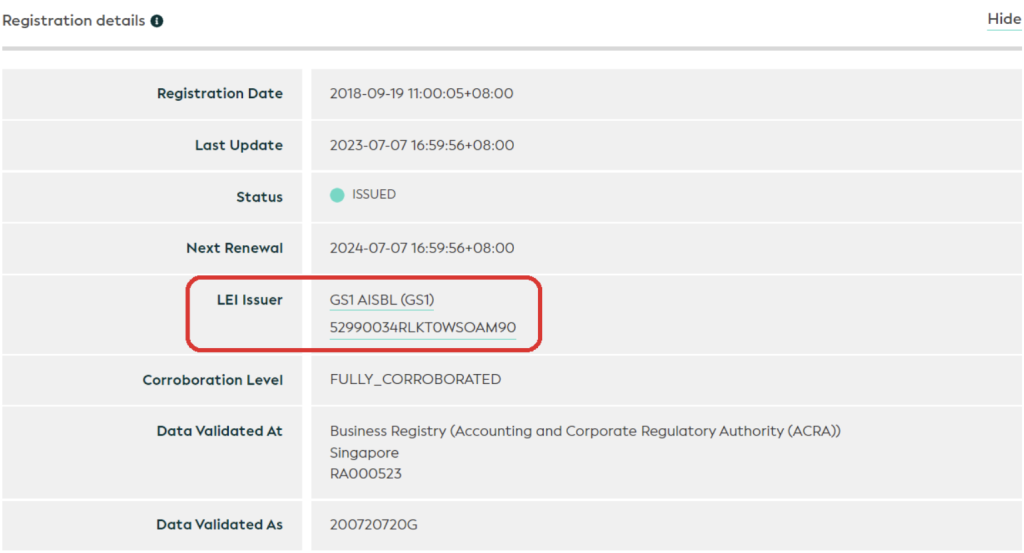
4. In the results page, scroll down to Registration Details and check the LEI Issuer
*For other LOUs handling your LEI, please contact them directly if you have any concern with your LEI.
*For other information, please refer to F.A.Q. GMEI EXIT RATIONALE AND TRANSFER PROCESS.
The global economy is facing unprecedented identity-related fraud, leading to significant financial losses and undermining trust between organizations, particularly in cross-border transactions. Financial crises have highlighted the importance of unique identification and understanding the connections between legal entities to effectively track and manage financial risks.
The Policy Conformity Flag is a simple, clear tool for global data users to determine whether individual LEI records meet certain Regulatory Oversight Committee (ROC) policies. An LEI labeled as ‘conforming’ indicates the following criteria have been met (along with the related benefits):
1. Fighting financial crime
2. Monitoring market risk
3. Enhancing Operational Processes
Legal entities are encouraged to ensure that their LEI record is “conforming,” i.e., compliant with the policies established by the ROC within the Global LEI System.
It is important to highlight that an LEI record marked as “conforming” represents a simple and effective solution available to legal entities to ensure basic compliance with many international regulations.
Click here to view more information on the GLEIF website.
Click here for the guide.
Welcome to GS1 Singapore's chat!
Hi I'm GS1 Bot and i can answer some common questions about....